The Great Reassembly of Finance
Long money, meet long assets: why Europe should let the annuity barons rebuild the capital chain
Abstract
Europe has two financial problems that are usually discussed separately, and they are the same problem. European savers are underinvested and underpaid, and the European economy is underfunded. Long money on one side, long assets on the other, and a financial system that no longer connects them. The prevailing story is that private equity is taking over life insurance and loading it with risk. That story mistakes the deals for the design. What is actually happening is bigger and, on the whole, better.
Europe has two financial problems that are usually discussed separately, and they are the same problem. The first is that European savers are underinvested and underpaid. Households hold more than 40% of their financial wealth in bank deposits, and trillions more in guaranteed life-insurance products crediting next to nothing: thirty-year retirement money parked in overnight instruments, paying a liquidity discount for liquidity its owners will never use. The second is that the European economy is underfunded. The Draghi report puts the continent's additional investment need at roughly €800bn a year. Long money on one side, long assets on the other, and a financial system that no longer connects them. The gap between the two is money left on the table, compounding annually, measured in the pensions Europeans will not receive and the infrastructure they will not get.
Something is now being built to close that gap. In the space of five days this spring, Britain's pension-insurance market changed hands: Athora, a retirement group built with Apollo Global Management's capital and origination engine, completed its £5.7bn purchase of Pension Insurance Corporation; Brookfield closed its £2.4bn takeover of Just Group; Blackstone had already signed a partnership to originate up to $20bn of private credit for Legal & General's £92bn annuity business. The prevailing story, told with mounting anxiety in a string of recent investigations, is that private equity is taking over life insurance and loading it with risk. That story mistakes the deals for the design. What is actually happening is bigger and, on the whole, better.
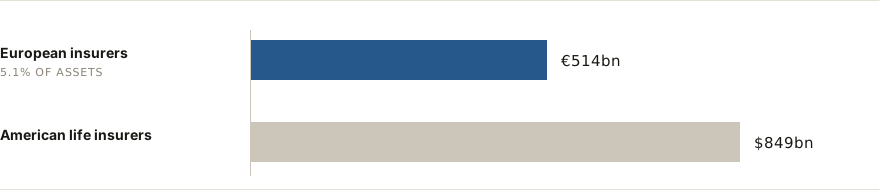
Finance's traditional taxonomy assigns each institution one transformation. Banking transforms maturity, turning short deposits into long loans. Insurance transforms uncertainty, converting a potentially ruinous loss into a small, predictable premium and, in turn, payouts or benefits. Asset management transforms capital, converting raw financial wealth into structured, goal-oriented portfolios. Together these three transformations once formed a chain that carried household savings out to the real economy and back. Over the past fifteen years each link broke in its own way. Banks broke by regulation: Basel made it uneconomic to hold thirty-year infrastructure loans against runnable deposits. Insurers broke by over-correction: scarred by negative rates, they de-risked into government bonds: two-thirds of European insurers' portfolios sit in low-risk fixed income at a median quality of AA, with sub-investment-grade holdings of just 1.3% and median life solvency of 235%, per EIOPA. Capital idling against liabilities that require neither the liquidity nor the safety being bought. Asset managers broke by drift, into public indices where passive vehicles are now the majority of US equity fund assets and a handful of stocks dominate every "diversified" portfolio. The consequence: European insurers hold €514bn of private credit, 5.1% of assets, while American life insurers hold $849bn and private-equity-backed American insurers alone account for more than $700bn of invested assets, a platform comparable to the entire European exposure.
Now consider the instrument at the centre of these deals: the bulk annuity. It cannot be surrendered, redeemed or run on: a deposit with no depositor, the one genuinely permanent form of funding in finance. Matching it with liquid government bonds is not prudence but waste. The textbook asset for such a liability is exactly the long, illiquid private credit the economy is short of, and Britain's matching adjustment rewards the fit explicitly. The binding constraint is not liabilities (Britain wrote a record £38bn of bulk annuities in 2025) but origination, and origination at scale is what Apollo, KKR, Brookfield and Blackstone own. The fit is not incidental to these deals. The fit is the deal.
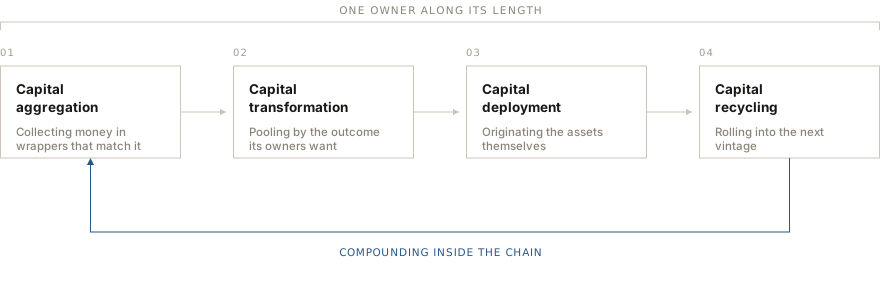
Seen from the system, the deals of the past eighteen months are firms assembling links of a single chain, non-sequentially, with one owner along its length:
- Capital aggregation: collecting fragmented money in wrappers whose permanence matches what the money is for: an annuity for the pensioner, a long-horizon wealth product for a young family.
- Capital transformation: pooling by the outcome its owners want; the annuity that is retirement security for the saver is permanent capital for the borrower, and the same euro is both.
- Capital deployment: origination of the assets themselves, the factories, data centres and grids that need decades-long money, matched to the duration, yield and risk tolerance flowing from the transformation stage.
- Capital recycling: maturing capital rolls into the next vintage rather than exiting, compounding inside the chain.
Each transformation once belonged to a separately regulated industry; the reassembly puts them under one roof, and the deals are firms choosing which links to own. Apollo/Athora and Brookfield bought the aggregation link outright. BlackRock took a consortium share of Viridium, Germany's closed-book consolidator. Blackstone owns no insurer and sells the deployment link's output to an incumbent. Different entry points, one blueprint. America ran the experiment first: Athene proved an origination engine bolted to permanent funding compounds faster than either alone. It also showed what Europe should not copy: nearly 70% of the $1.1trn ceded offshore by American insurers sits with affiliated reinsurers, partly supervised outside the perimeter.
A working chain pays out at both ends. Viridium's largest carrier has allocated around €1bn more to policyholder premium refunds since consolidation and raised its minimum guarantee from 1.25% to 2.35%, with lapse rates among the market's lowest. British annuity writers lifted domestic investments by £22bn to £201bn in 2024, two-thirds of new capital going to private and unlisted assets. Scale it up: every 100 basis points of additional net yield on €5trn of genuinely long-term European savings is €50bn a year for savers, roughly a quarter of a percent of EU GDP, compounding.
The bill is real, and it is the mirror of the advantage: everyone in the chain works for the same shareholder, so the risks are incentive risks. Conflicted pricing: internal transactions at prices nobody negotiated at arm's length. Wrong-way risk: the insurer's assets correlated with its owner's health. And the marks: private assets valued by the manager, with a lag, untested in Europe through a full credit cycle. Eurovita, the private-equity-owned Italian insurer that collapsed in 2023 when rising rates triggered a lapse surge, wrote the design rule: the test is not what a product is called but whether the policyholder has a cash value to run to. A UK annuity in payment has none; Eurovita's savers had one, and used it. And S&P's July stress test of a UK insurer with 12% of its portfolio in private credit found capital sufficient for a 2008-scale shock: the risks are conduct, not arithmetic.
The fence, meanwhile, is being built. Britain's regulator loosened where the fit is real (a 65% risk-margin cut, wider matching-adjustment eligibility, an investment accelerator) and tightened where the arbitrage was, proposing capital for funded reinsurance as if the insurer held the assets directly, closing a gap of 2-4% held against 11-15% for comparable direct investment. Two improvements remain: genuinely conflict-free valuation of assets originated, managed and marked by the same group; and real first-loss skin in the game for the owning managers, without which the structure resolves to heads I win, tails I win. Athora's decision to move its headquarters from Bermuda to London, accepting group supervision, suggests the bargain is being accepted. Onshore, supervised, capitalised for the risk retained: the PRA is not resisting the model. It is domesticating it, and EIOPA should study the template as the Dutch pension transition moves over €1.2trn from 2028, Germany's back-books consolidate, and France's surrenderable fonds euros mark the boundary the model must respect.
Europe can decline the reassembly: keep the chain broken, let savers keep earning the deposit rate, and watch the reassembly happen anyway, in Bermuda and Delaware, with Europe's savings exported into it as customers rather than hosts. Or it can admit the chain behind an honest fence. The first generation of reassembled firms will be judged on whose interests the chain served when the marks finally move; the fence exists so the answer can be everyone's. Long money and long assets have finally found each other. The only genuinely reckless option left is keeping them apart.