I went through five years of annual reports, every investor day and results transcript I could find, and the regulator's own speeches for the UK bulk annuity market. That covers L&G, Aviva, PIC, Rothesay, Standard Life, Just, M&G, Canada Life, Royal London and the newer entrants. This is the short version, as at the end of September 2026.
Demand is abundant but no longer automatic
UK defined benefit schemes have never been better funded. The PPF measure put aggregate funding at 133% at the end of August, a surplus of £274bn.3 The Pensions Regulator estimates about 60% of schemes could afford a full buyout.4
Volume still fell. It was £47.8bn in 2024, £38.2bn in 2025 and £10.2bn in the first half of 2026.1 Almost all of the decline is the number of very large deals. There were 14 over £1bn in 2024, 7 in 2025 and 1 in the first half of this year. Below £1bn, the market has been steady at around £20bn a year since 2020, and the number of deals has more than doubled, mostly from schemes under £100m.2
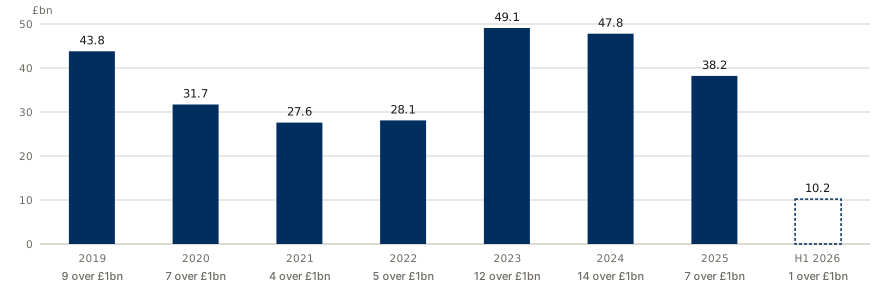
The constraint is now trustee choice, not affordability. The biggest schemes have options. BT, Lloyds and the BBC hedged longevity in 2025 instead of buying out. The Pension Schemes Act 2026 lets schemes release surplus from April 2027 and creates a permanent superfund regime from 2028. The January forecasts all said £50bn or more for 2026. LCP now says £35–40bn.1 I would plan on £35–45bn a year.
Capacity outran demand, and margins paid for it
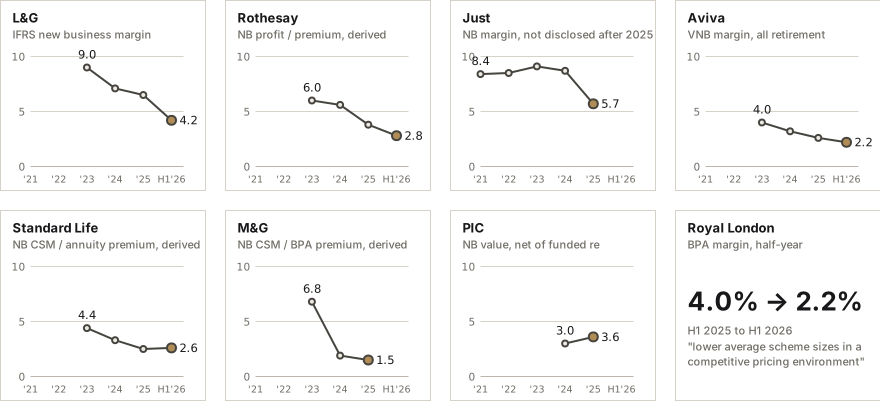
Eleven insurers were quoting at the peak, insurer appetite was put at up to £70bn a year, and scheme pricing is now the best on record, about 0.3% a year or more above the return on gilts.2 The cost shows up on the insurer side. Every insurer that discloses a new business margin shows the same shape: a peak in 2023 or 2024, a sharp fall in 2025, and lower again in the first half of 2026.
| Insurer | Measure | Peak | Latest |
|---|---|---|---|
| L&G | IFRS new business margin | 9.0% (2023) | 4.2% (H1 2026) |
| Rothesay | New business profit over premium | about 6% (2023) | 2.8% (H1 2026) |
| Just | New business margin | 9.1% (2023) | 5.7% (2025) |
| Aviva | VNB margin, all retirement products | 4.0% (2023) | 2.2% (H1 2026) |
| Royal London | BPA new business margin | 4.0% (H1 2025) | 2.2% (H1 2026) |
L&G's new business margin went from 9.0% to 4.2% and its UK strain rose from about 1% to 3.1%.5 Rothesay's new business profit went from £886m in 2024 to £197m in 2025 and £77m in the first half of 2026.8 Royal London's margin nearly halved in a single year, which it put down to "lower average scheme sizes in a competitive pricing environment".15 PIC is the one exception, and its figure is stated after the benefit of funded reinsurance.
The profit story has moved to the back book
New business is now priced largely on gilts, with the intention of rotating into higher-yielding credit later. L&G's sovereign holdings rose from 10% to 29% of annuity assets. Profit growth depends on that rotation and on recurring management actions. In the first half of 2026, £227m of the £646m of profit in L&G's institutional retirement business came from what it calls asset optimisation.5 At Standard Life, recurring management actions were 37–38% of operating cash generation in 2024 and 2025.9
L&G's head of institutional retirement put the model plainly: they "preferred to print an underwritten new business margin at 4.2%", keeping the optionality to trade up later.6 This works if credit spreads widen or private origination keeps scaling. If spreads stay tight, the back book can carry the story for only so long.
The headline measures have moved at the same time. Aviva now leads with an IRR rather than a margin. Standard Life went from "mid-teens" to "lifetime IRRs of more than 20%", which is mostly a change of definition. Rothesay dropped market-consistent embedded value for new business, then embedded value altogether. Just, under new ownership, no longer publishes its margin, strain or cash generation. Less disclosure at the point where the economics weaken is worth noticing.
Funded reinsurance gets more expensive
The PRA's language on funded reinsurance hardened steadily, from "could pose a risk" in 2022 to a capital proposal in April 2026. Under CP8/26, the capital held against funded reinsurance would rise from about 2–4% of the liabilities covered to about 10%, for risk transferred after 30 September 2026, with the rules applying from July 2027.11 It is still a consultation.
The effect is uneven. Rothesay has never used funded reinsurance. Aviva uses it lightly and M&G does not use it. L&G is more exposed: funded reinsurance was 19% of its 2025 premium, and its first-half margin already assumes £432m of reinsurance it had not yet signed.5 PIC was an early and consistent user.
The balance sheets are changing hands
In eighteen months, much of the market's capital has moved to asset managers. Athora, whose shareholders include Apollo and Athene, completed its purchase of PIC in March 2026. Brookfield completed Just in April. A group led by CVC with Prudential Financial, Goldman Sachs and MS&AD is putting up to £2bn into a Standard Life vehicle for schemes above £2bn.13 L&G routes part of its new business assets through Blackstone.
The early behaviour is thin evidence but worth watching. PIC wrote £0.3bn of new business in the first half of 2026 while remitting €462m to Athora.12 Brookfield changed Just's chief executive within weeks of completion and cut its disclosure. The Bank of England's July Financial Stability Report linked the acquisition of two large UK life insurers by US private capital to insurers' private-markets exposure.14 I wrote about the institutional side of this in The Necessary Marriage, the Messy Aftermath.
The language moved in the same order everywhere
Reading the transcripts in sequence, the vocabulary moved through the same four stages at almost every insurer: growth, then capital-light, then discipline, then returns and optionality. Two habits stand out.
Volume targets are relabelled rather than missed. Aviva said in November 2022 it was "committed to the 15 to 20 billion". In 2024 that became "an ambition, not a target". L&G's £50–65bn for 2024 to 2028 is now "guidance", and its chief executive said in August that he "would be comfortable if we didn't meet it for the right reasons".6 Group cash and capital targets, by contrast, are almost always met, often early.
"Discipline" follows volume down. Rothesay used the word twice in its 2023 annual report, its boom year, and 19 times in its 2025 report, when volume fell by two thirds. The word explains lower volume after the event. It has not predicted it.
What to watch
Each of these has a date and a number attached, so the next update can score them rather than re-argue them.
- The PRA's final rule on funded reinsurance. CP8/26 is a consultation, not a rule. If the 10% charge survives close to intact, the insurers that used funded reinsurance to compete on price lose that edge: L&G, with 19% of 2025 premium reinsured, gives up most, and Rothesay, which has never used it, gives up nothing. If it is softened materially, four years of hardening language will have ended in very little.
- Whether L&G's fourth-quarter pipeline closes. The distance between £35bn and £45bn for 2026 is a handful of large deals. If they land, the jumbo market was pausing. If they slip again, 2025 was not a pause, and £35–45bn a year is simply the level.
- Standard Life's capital markets update on 30 November. The first look at what the CVC vehicle earns. Watch whether it reports a margin at all or only an IRR. Standard Life has already moved from "mid-teens" to "lifetime IRRs of more than 20%" without the underlying economics changing, so another step of definition would tell you more than the figure does.
- What PIC and Just write in the second half. PIC wrote £0.3bn in the first half while remitting €462m to Athora. If the second half looks like the first, the acquired balance sheets are being run for cash rather than for volume, and the capacity that made pricing competitive is leaving the market. Reinsurance into affiliated offshore entities is the specific thing to look for, because it moves risk without moving the headline.
- The government's response on surplus release, and the first assessed superfunds. Both let a scheme stop short of buyout. Every scheme that takes one is demand that never arrives.
Margin definitions differ by company, so the comparison above is about direction, not level. Some figures are derived from disclosed numbers rather than published by the company.