A wave of private-capital acquisitions and partnerships has moved through European life insurance and annuities. Much of the commentary has focused on the risks. This piece looks at the same events as a question of capital design.
I. A new landscape has formed
Europe has two financial problems that are usually discussed separately but have a common missing link. The first is that too much European household wealth remains in instruments designed for liquidity rather than long-term accumulation. Households hold more than 40% of their financial wealth in bank deposits, while large pools of insurance savings are also invested conservatively. The second is that the European economy needs vastly more long-term investment. The Draghi report estimated an additional investment requirement of roughly €800bn a year.1 Infrastructure alone accounts for about €12.2tn between 2025 and 2040, of which roughly €5.8tn will not be delivered at the current pace.2
Long money on one side. Long assets on the other. A financial system that no longer connects them efficiently.
The opportunity is not to turn every euro of savings into private credit. It is to match the characteristics of the liability with the characteristics of the asset: liquidity with liquidity, duration with duration, and risk-bearing capacity with risk.
Something is now being built to do exactly that.In the space of five days this spring, Britain's pension-insurance market changed hands: Athora, backed by Apollo Global Management's capital and origination engine, completed its £5.7bn purchase of Pension Insurance Corporation; Brookfield closed its £2.4bn takeover of Just Group; and Blackstone had already signed a partnership to originate up to $20bn of private credit for Legal & General's £92bn annuity business.
The prevailing story, told with mounting anxiety in recent investigations, is that private capital is taking over life insurance and loading it with risk. That interpretation focuses on the ownership change. The more consequential development is the architecture being assembled underneath it. The industry is reconnecting three capabilities that had become increasingly separated: collecting long-duration capital, manufacturing liabilities, and originating long-duration assets. That is a different proposition from simply moving assets from public to private markets.
II. The old capital chain has been altered
Finance's traditional taxonomy assigns each institution a different transformation.
- Banks transform maturity: taking relatively short-term deposits and making longer-term loans.
- Insurance transforms uncertainty: pooling heterogeneous risks and turning them into predictable premiums and benefits.
- Asset managers transform capital: converting accumulated financial wealth into portfolios designed around particular objectives.
Together, these transformations once formed a chain carrying household savings into the real economy and back again.
Over the past fifteen years, the links have become less effective. Banks face capital and liquidity requirements that make some long-dated lending less attractive to hold on balance sheet. Insurers, scarred by the negative-rate era and constrained by their own capital and risk requirements, have often become more conservative in asset allocation. EIOPA data show European insurers remain heavily concentrated in high-quality fixed income.3 The direction of travel is nonetheless visible in the credit books themselves: private markets have gone from about a quarter of life insurers' bond holdings in 2009 to nearly half by 2024.4 Asset management, meanwhile, has increasingly concentrated around liquid public markets and scalable distribution.
The result is not that capital disappeared. It is that the institutions holding the capital became less naturally connected to the assets requiring it. A new order is forming around the reconnection of those links. Insurance and private markets are its first major joint.
III. The design is not new. Buffett built an empire on it.
Berkshire Hathaway bought National Indemnity in 1967 and has deployed insurance float ever since: the capital held between receiving premiums and paying claims. That float stood at $176bn at the end of 2025.5
The underlying idea is therefore hardly new. What is changing is the instrument and the scale. Buffett put insurance float into businesses and securities that could, in principle, be sold any day. The discipline came primarily from the investor: he could tolerate volatility and refuse to sell.
Annuity platforms can create a different form of discipline. A sufficiently stable annuity liability can provide a long-duration funding base against which the insurer can hold assets whose liquidity is lower but whose expected cash flows, duration and risk characteristics are appropriate for the liability. The important point is not that illiquid assets automatically match long liabilities. They do not. The point is that certain liabilities create a structural capacity to own assets that would be unsuitable for a liability book requiring immediate liquidity. That distinction matters. A surrenderable savings product and a bulk purchase annuity may both appear on an insurer's balance sheet as long-term liabilities. Economically, they are very different.
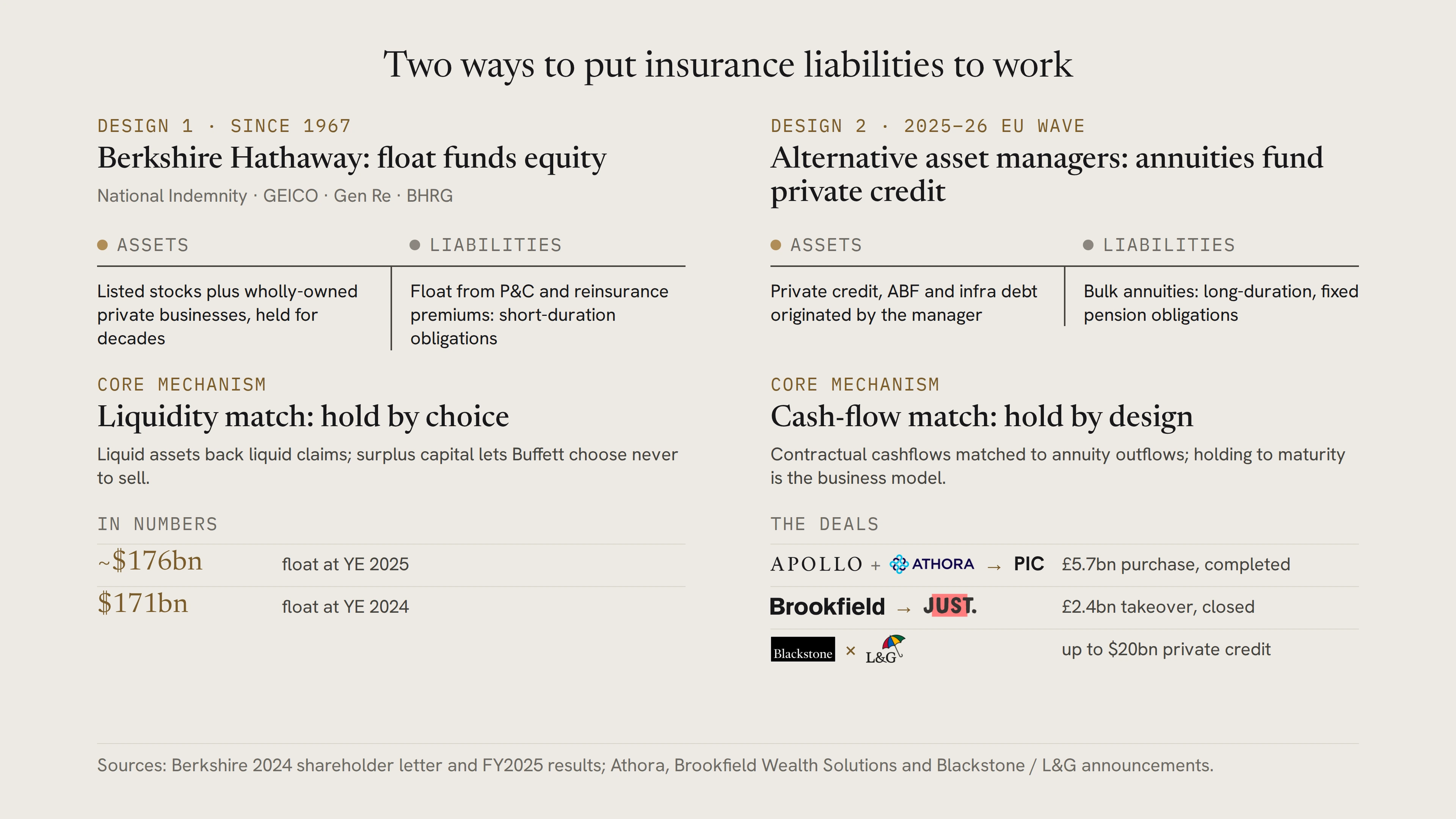
Now consider the instrument at the centre of many of these transactions: the bulk annuity. Once in payment, a bulk annuity generally cannot be surrendered or redeemed by an individual policyholder. Its cash-flow behaviour is therefore fundamentally different from a deposit or a retail savings product. For such liabilities, holding only liquid government bonds is not necessarily prudence. It can also mean paying for liquidity the liability does not require. The appropriate question is not:
How illiquid can an insurer become? It is: How much illiquidity can the liability structure safely support?
That is a much more useful investment question.
Britain wrote a record £38bn of bulk annuities in 2025. The opportunity therefore is not principally a shortage of liability demand. It is the ability to originate enough assets with the right combination of duration, cash-flow certainty, credit quality, yield and capital efficiency to back that demand. That is where the alternative managers have an advantage. The fit is not incidental to these transactions. Increasingly, the fit is the business model.
IV. The next step: manufacturing both sides
Apollo's new Austin hub offers a glimpse of where the model could go. On 3 August 2026 Apollo announced Austin as the site of a new hub led by Eric Needleman, who heads Apollo Capital Solutions, and Mike Downing, chief operating officer of Athene Holding. Apollo described the hub as a place to incubate businesses across asset management and retirement solutions, organised around product, distribution, infrastructure and market-making.6 Read the pairing rather than the press release. Capital Solutions is where assets are structured and syndicated. Athene is where insurance liabilities live. Putting origination and the balance sheet under one roof creates the possibility of something more ambitious than vertical integration of existing businesses:
Designing the liability and the asset together.
Apollo has not publicly said that this is the purpose of the Austin structure. That is my interpretation. But if the industry moves in this direction, the implication is significant. Traditional financial intermediation starts with assets and liabilities that already exist and connects them. The emerging model can increasingly manufacture both ends of the balance sheet. A retirement product can be designed around a particular liability profile. Assets can then be originated with the duration, cash-flow characteristics and risk required to support it.
The capital chain becomes:
Capital aggregation → liability transformation → asset origination → productive investment → cash-flow generation → capital recycling
Each step once belonged largely to a separately regulated industry. The new institutions are assembling multiple links under common ownership.That is what makes the current wave of transactions more consequential than another round of consolidation.
V. One owner, one capital chain
The emerging architecture can be understood through four functions.
Capital aggregation
Collect fragmented household and institutional savings into vehicles whose duration matches what the money is actually for: retirement security, long-horizon wealth or other long-term objectives.
Capital transformation
Pool that money into liabilities with defined cash-flow characteristics. The same euro can therefore become retirement security for the saver and long-duration funding for the borrower.
Capital deployment
Originate assets, infrastructure, asset-backed finance, private credit and other long-duration investments, whose cash flows and risk characteristics fit the liability base.
Capital recycling
As assets mature, capital can be redeployed into subsequent vintages rather than repeatedly leaving the platform and being raised again externally.
This is the economic attraction of the integrated model. It is not merely that an asset manager owns an insurer. It is that multiple stages of capital formation, transformation and deployment can operate as one system. Apollo/Athora and Brookfield have taken ownership of the aggregation side.Blackstone has pursued the deployment side through partnerships with incumbent insurers. BlackRock's consortium investment in Viridium represents another route into the chain. Different entry points. Increasingly similar architecture.
America ran the experiment first. Athene demonstrated the potential of combining large-scale origination with a durable insurance funding base. It also demonstrated the perimeter risk Europe should not ignore: nearly 70% of the $1.1trn ceded offshore by American insurers sits with affiliated reinsurers, with parts of those structures supervised outside the domestic perimeter. The lesson is therefore not simply "copy America." It is:
Integrate the economics without exporting the risks outside the regulatory perimeter.
VI. The advantage has a bill attached
A working capital chain should pay out at both ends. There is evidence that consolidation can change the economics available to policyholders. Viridium's largest carrier has allocated around €1bn more to policyholder premium refunds since consolidation and raised its minimum guarantee from 1.25% to 2.35%. British annuity writers increased domestic investments by £22bn to £201bn in 2024, with two-thirds of new capital going to private and unlisted assets.
The potential economic value is substantial. As an illustration, if €5trn of genuinely long-term European savings earned an additional 100 basis points of net return, the arithmetic would be €50bn a year before considering additional risk, capital requirements, fees or losses. That is not a forecast. It is simply a measure of the size of the prize if the financial system can connect long-duration capital to productive assets more efficiently. But integration creates a corresponding governance problem. When the same group controls multiple links in the chain, the conflicts become internal rather than external.
There are at least three obvious ones.
Conflicted pricing: transactions between affiliated entities may not be priced as they would be between independent parties.
Wrong-way risk: the insurer's assets, liabilities or counterparties may become correlated with the financial condition of its owner.
Information and valuation risk: private assets may be originated, managed and valued within the same broader group, reducing the number of independent reference points available to challenge the marks.
The problem is therefore not that vertical integration is inherently bad. It is that integration removes some market frictions while simultaneously removing some of the external checks that used to discipline them. That is the trade. Eurovita provides the clearest reminder that liability behaviour matters more than product labels. When rising rates triggered a surge in lapses at the Italian insurer in 2023, the problem was not simply that its assets were illiquid. Policyholders had a cash value they could run to. A bulk annuity in payment is economically different because the policyholder does not have the same redemption option.
The design rule is simple:
Do not ask whether a product is called an annuity. Ask whether the policyholder has a cash value to run to.
That distinction determines how much illiquidity the liability can safely support.
VII. The regulatory bargain
The regulatory response is therefore not simply a choice between permitting and prohibiting private assets.It is about determining which parts of the integrated model create genuine economic efficiency and which merely create regulatory arbitrage. Britain has moved in both directions: reducing the risk margin, widening matching-adjustment eligibility and introducing an investment accelerator, while also proposing tougher treatment of funded reinsurance where capital relief may otherwise exceed the underlying economic risk.7 That is the right direction of travel. The principle should be:
Give capital credit where the economic risk has genuinely changed. Remove the credit where only the legal structure has changed.
Two areas deserve particular attention.
First, valuation: if the same group originates, manages and values a private asset, the insurance balance sheet needs a genuinely independent challenge function. The issue is not whether the manager is acting dishonestly. It is whether a system with no independent price discovery can reliably identify deterioration before it becomes a capital problem.
Second, incentives: the economics of origination should not be separated from the downside of poor underwriting. If an owner captures origination and management economics while transferring most tail risk to an insurance balance sheet, integration becomes an exercise in extracting value rather than creating it. The regulatory objective should therefore not be to keep the links apart.It should be to ensure that the owner of the chain cannot privatise the upside while socialising the downside. Athora's decision to move its headquarters from Bermuda to London and accept group supervision is one indication of where the institutional bargain may be heading. Onshore. Supervised. Capitalised for the risks actually retained. That is not the rejection of the model. It is its domestication.
VIII. Europe has a choice
European insurers hold around €514bn of private credit, or 5.1% of assets, while American life insurers hold around $849bn. Private-equity-backed American insurers alone account for more than $700bn of invested assets.3 The question for Europe is therefore not whether this model will exist. It already does. The question is where the capital chain will be owned, governed and operated. Europe can leave the chain fragmented, with household savings remaining heavily exposed to low-risk, liquid instruments while long-term investment is increasingly financed by institutions headquartered elsewhere. Or it can allow the chain to be rebuilt domestically, subject to an honest regulatory perimeter. The second option does not mean assuming that every alternative asset is suitable for every insurance liability. It means recognising that a well-designed insurance balance sheet can be more than a passive holder of bonds. It can be an institutional bridge between long-duration savings and long-duration investment. That bridge becomes more powerful when origination, liability design and capital deployment are connected. It also becomes more dangerous when governance fails.
The first generation of reassembled firms will therefore be judged not by how much private credit they own, but by what happens when the marks move, defaults arrive and incentives are tested. If the answer is that policyholders remain protected, capital remains resilient and productive investment receives more patient funding, the reassembly will have created something valuable. If the answer is that returns were manufactured through leverage, affiliated transactions and optimistic marks, the same architecture will have amplified risk.
Long money and long assets have finally found each other.
The question for Europe is no longer whether they should meet. It is whether Europe can build the institutions capable of making the marriage work.