The marriage between alternative asset managers and life insurers and annuity providers is not difficult to understand: one side has assets; the other has liabilities.
Alternative asset managers have spent the past decade building origination capabilities across private credit, asset-backed finance, infrastructure debt, real estate and other forms of private financing. Life insurers, meanwhile, sit on enormous pools of long-duration capital that need to earn a return while supporting promises that may extend for decades. In the past, insurers were flirting with private markets through relatively small allocations. Now we are seeing a more structural marriage through acquisitions and partnerships.
The economics are compelling, but the real difficulty begins after the wedding.
The question is whether a combined institution can continuously know what it owns, what it is worth, and whether it will produce the cash when the liability needs it, independently of the incentives of the manager selecting and managing those assets, and whether it can give regulators confidence that policyholders remain protected.
That is the part of the marriage that is much less glamorous. It may also determine whether this becomes a durable transformation of insurance investing or simply another cycle of financial engineering.
The marriage makes sense
There is a temptation to view the growing relationship between alternative asset managers and insurers primarily through the lens of regulatory arbitrage. That misses the economic logic. For insurers, private assets can offer additional spread, long-duration cash flows, diversification and access to differentiated origination. For alternative asset managers, insurers offer something equally valuable: large pools of relatively sticky capital with liabilities that can support long investment horizons.
The attraction is particularly obvious in private credit and infrastructure debt. Borrowers need long-term financing; investors can potentially earn an illiquidity premium for accepting less-traded assets. EIOPA reported that European insurers held more than €500 billion of private-credit investments at the end of 2025, around 5% of total assets, while also highlighting the associated risks around leverage, liquidity, valuation and concentration.1
The regulatory framework itself recognises the economic logic. Under Solvency II's matching adjustment framework, qualifying assets can be matched against portfolios of insurance obligations, with expected asset cash flows required to replicate liability cash flows subject to specified conditions.2 So the basic proposition is sound:
Long-duration liabilities can create capacity for long-duration assets.
But that does not mean that the institutional machinery required to support the assets is already adequate. An insurer buying a private asset is not simply buying an investment. It is putting that investment behind a promise to a policyholder. That distinction changes everything.
Two institutions, two questions
An alternative asset manager is fundamentally trained to ask:
Is this a good investment? The insurance balance sheet has to ask a harder question: Is this asset sufficiently reliable, appropriately valued and resilient enough to support a promise that may exist for decades?
Those questions overlap. They are not identical.
A private-credit investment can have an attractive expected return and still be inappropriate for a particular insurance portfolio. The insurer is not simply buying return. It is buying return alongside cash-flow reliability, duration, liquidity, capital efficiency, resilience and valuation credibility.
This is why the rise of private assets inside insurance is not merely an asset-allocation shift. It is an operating-model shift. The manager may originate the loan. It may manage the portfolio. It may even provide the valuation. But the insurer remains the institution standing behind the liability. The manager can be wrong about an investment. The insurer can be wrong about whether it can safely support its promises with that investment. Those are different kinds of mistakes.
The problem with assets you cannot easily see
The first challenge appears after underwriting. A private loan does not come with a continuously traded market price telling the owner that the original investment thesis is deteriorating. The important question is therefore not simply whether it was a good investment when it was bought. It is:
How does the institution know that it is still a good investment today?
That requires continuous surveillance of the underlying economics: borrower financials, collateral, covenant headroom, payment behaviour, leverage, refinancing dependence and the performance of the underlying pool. This matters particularly for asset-backed finance, infrastructure debt, direct lending, specialty finance, real-estate lending and structured credit. The risk is therefore not just underwriting risk. It is underwriting decay risk. A portfolio can remain technically within its original mandate while the economic quality of the underlying exposures gradually changes. The investment committee may still be looking at the same asset. The asset may no longer represent the same economic proposition.
Valuation makes this problem harder. In a liquid market, deterioration becomes visible through price. A bond falls, a spread widens, a transaction clears at a lower level. In a private market, deterioration can happen without an equivalent observable price. Credit quality can weaken, collateral can deteriorate, recovery expectations can fall and refinancing risk can increase while the asset continues to be carried using a model-derived valuation. The absence of a transaction does not mean the absence of a change in value. Indeed, it creates the opposite problem: the less frequently an asset trades, the more important the valuation process becomes, and the less observable the answer is. That matters beyond financial reporting. Valuation feeds capital; capital affects investment capacity; investment capacity affects portfolio construction; and portfolio construction affects the insurer's ability to support its liabilities. Valuation is therefore part of the risk architecture, not an accounting footnote.
Ratings do not solve the problem. A private asset and a publicly traded security can carry the same rating while having very different liquidity, transparency, documentation, recovery characteristics and cash-flow uncertainty. A rating is useful information. But it is not a valuation, it is not liquidity, and it is not a guarantee that cash will arrive when expected. That distinction becomes increasingly important as insurers move into assets whose risks are less observable than those of traditional public bonds.
Long duration is not the same as no liquidity need
The second problem is liquidity. An annuity book can be extremely long duration. That does not mean the insurer will never need cash. Policyholders can surrender. Collateral can be called. Reinsurance settlements can occur. Derivatives can generate margin requirements. Assets and liabilities may need to be rebalanced. A private loan may ultimately repay in full and still create a liquidity problem if it does not repay when the balance sheet needs the cash. This is why duration and liquidity should not be treated as synonyms. The conventional private-credit investor can focus heavily on expected return and exit economics. The insurer has to think about the entire distribution of possible cash flows against its liabilities. The question is not simply whether an asset will pay. It is when it will pay, how much it will pay, and what happens if it pays later than expected.
The same applies to diversification. An insurer can own 100 assets through 20 managers across 10 sectors and appear highly diversified. But if those exposures ultimately depend on the same sponsors, geographies, collateral types or financing channels, the portfolio may contain one large economic bet. The relevant question is therefore not how many funds or managers the insurer owns. It is:
What economic risks do we actually own?
That requires looking through the structures rather than stopping at the fund level. EIOPA has highlighted concentration, hidden leverage and interconnectedness as concerns in private-credit portfolios.1 Private markets do not create concentration risk. They simply make it harder to see.
The conflict that comes with integration
The most interesting problem emerges when the alternative manager does not merely manage assets for the insurer. It owns the insurer. The same group can increasingly influence origination, structuring, asset management, valuation and insurance capital allocation. That integration can be economically powerful. It can reduce duplicated costs, improve information flows and allow assets to be designed around the needs of the insurance balance sheet. But it also removes some of the distance between the institution making the investment decision and the institution supplying the capital.
That creates potential conflicts around affiliated transactions, fees, transfer pricing, valuation, asset allocation, reinsurance and investment mandates. EIOPA's 2026 supervisory work explicitly highlights the need for arm's-length terms and independence of investment decisions where affiliated asset managers and insurers sit within the same group.3
The important question is therefore not whether conflicts exist. They inevitably can. The question is whether the operating model is designed on the assumption that they will exist. That is a much more useful governance question. There is another problem that receives less attention: information.
A large private portfolio can contain hundreds or thousands of exposures, each with different covenants, legal documentation, payment schedules, collateral, waterfalls, triggers, amendments and valuation methodologies. The insurer still has to turn all of this into capital calculations, ALM, liquidity projections, risk reporting and regulatory disclosures. The deceptively simple question is:
Can the insurer actually see through the asset?
If not, an institution can have excellent investment professionals and still have poor risk management. The more complex the asset, the more important the information architecture becomes.
The operating model has to change
This is why the answer cannot simply be "more regulation". Regulation can set minimum standards. It cannot create an institution capable of understanding thousands of complex assets every day.
The industry is already adapting. Alternative managers increasingly have dedicated insurance-solutions teams working with actuaries and insurance investment specialists. But the capability gap goes beyond having people who understand both sides. The insurer needs its own ability to challenge the investment manager.
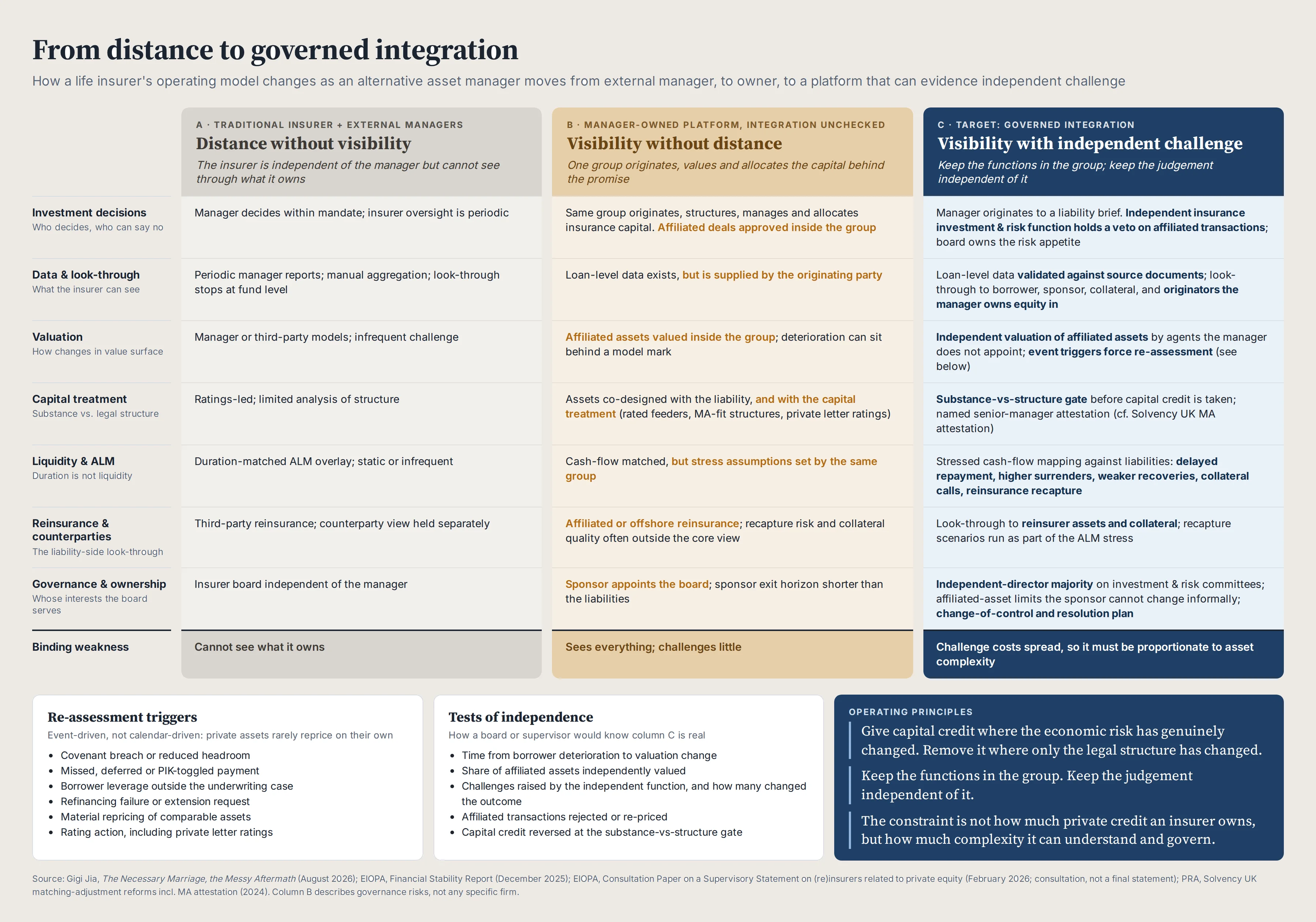
That does not mean duplicating the manager's investment team. It means having independent access to the underlying data and enough expertise to test the manager's assumptions: borrower leverage, covenant headroom, collateral performance, payment behaviour, expected cash flows and changes in risk. The same principle should apply to valuation. Not every private asset can be marked to market every day, but changes in borrower metrics, covenant breaches, missed payments, refinancing problems or material repricing in comparable assets should trigger reassessment. The objective is not to eliminate valuation uncertainty. It is to make that uncertainty visible before it becomes a balance-sheet problem. The biggest conceptual shift may be in ALM. The question should not simply be "what is the portfolio yield?" or even "what is the portfolio duration?" It should be:
What cash flows does this portfolio actually produce under stress, and how do those cash flows map against the liabilities?
That means testing delayed repayments, higher surrenders, defaults, weaker recoveries and liquidity shocks. A portfolio should be managed not only around duration but around cash-flow resilience. Finally, the institution needs to preserve independence where it matters most. The investment manager can originate and manage the assets. The insurance investment and risk function must be able to challenge them. The board and investment committee must retain ownership of the ultimate risk appetite. The principle is simple:
Outsource investment management. Never outsource accountability.
From asset management to balance-sheet management
This is ultimately what makes the alternative-manager and insurance combination so interesting. At its most integrated, it is no longer simply an asset manager with an insurance company attached, nor an insurer that happens to own an asset manager. It becomes a balance-sheet management platform. The asset manager brings origination and investment expertise. The insurer brings long-duration liabilities and a permanent pool of capital. Together they can potentially design assets, liabilities and capital allocation as one system. That can be a powerful advantage. But it also means that responsibilities which were previously distributed across different institutions become concentrated in one group. Vertical integration can reduce friction, but it can also reduce independent challenge. It can improve information flows while concentrating information. It can align incentives while creating new conflicts. The question is therefore not whether integration is inherently good or bad. It is whether the institution has enough governance and infrastructure to capture the benefits without allowing risks to compound invisibly.
That is where regulators have an important role. EIOPA's recent work is increasingly focused on exactly these issues: private credit, complex ownership structures, valuation, illiquid assets, conflicts and controls proportionate to asset complexity.3 At the same time, EIOPA recognises the role private credit can play in providing long-term financing to the economy. The regulatory objective should not be to preserve a boundary between "traditional" insurance investments and alternatives simply because the latter are harder to understand. Nor should private assets receive capital advantages merely because they have been placed inside an insurance structure. The principle should be straightforward:
Give capital credit where the economic risk has genuinely changed. Remove it where only the legal structure has changed.
And make institutions demonstrate that they understand what they own.
The real prize
The debate around alternative managers and insurance is often framed around how much private credit insurers should own. I think the more interesting question is different:
How much complexity can an insurance institution understand, govern and operate safely?
That may become the real constraint. Alternative managers are increasingly capable of originating private credit, infrastructure debt, asset-backed finance and other long-duration assets at a scale that traditional insurers could struggle to replicate themselves. They can potentially design those assets with the insurance liability in mind from the beginning. That is the opportunity. But it creates a corresponding obligation. The platform has to know what it owns, what it is worth, what could make that value deteriorate, when the cash will arrive, what happens if it does not, where concentration really sits, and whether the person making the investment decision has incentives that differ from the institution carrying the liability.
This is not bureaucracy. It is the infrastructure required to make the model work.
The marriage between alternative asset managers and life insurance is therefore likely to continue. The economics are simply too compelling, but putting private assets onto an insurance balance sheet is the easy part. The harder part is building an institution capable of seeing through those assets, challenging their valuation, understanding their cash flows and governing the conflicts that come with owning them. The future of insurance investing may therefore be determined less by who can originate the most private assets than by who can understand and operate them safely at scale.
That is the necessary marriage.
The messy aftermath is the institutional plumbing that makes it durable.